Introduction
In the competitive landscape of Custom Parts Production, there are always challenges in terms of increased lead times and costs associated with complex geometries for Custom Parts Production. The conventional multiple-step process for machining these complex geometries has been a major constraint for companies in terms of increased product development times and hence negative impacts on profitability. The reason for this has been the conventional approach of using 3-axis machining methods that require multiple setups for machining operations.
This article delves into how a 5 Axis CNC Machining Service represents a technological leap forward, fundamentally restructuring the manufacturing workflow. By enabling single-setup precision, facilitating online collaboration, and optimizing for manufacturability from the outset, it provides a systematic solution to the twin challenges of delivery and cost. The exploration of the following five key questions will reveal the core logic behind efficient Digital Manufacturing Services.
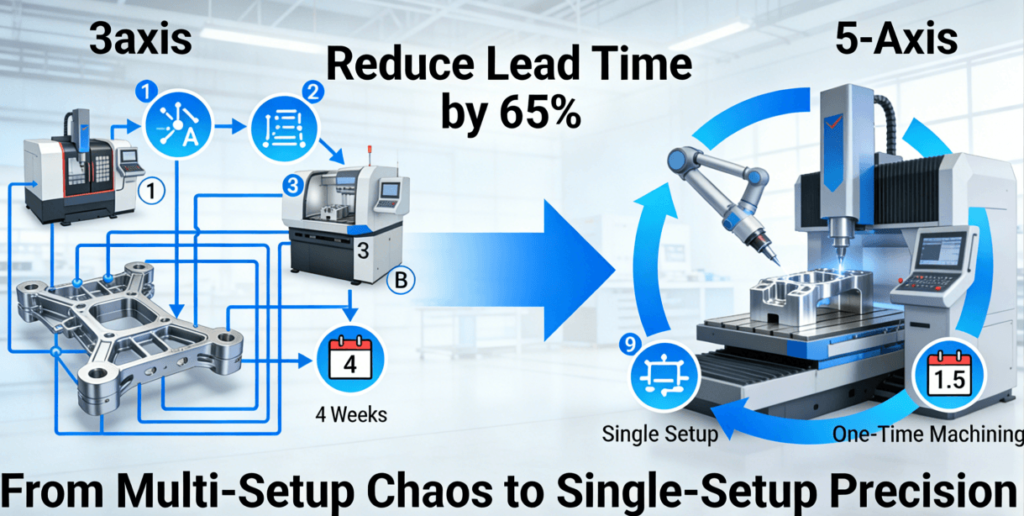
How Does 5-Axis CNC Machining Cut Lead Times for Complex Parts by 65%?
The conventional manufacturing process for such intricate parts has an inherently sequential nature. A part may need to be moved from a 3-axis milling machine to perform one set of features, to another machine to perform another set of features such as drilling angled holes, and so on. This “stop-and-go” process is the major bottleneck. Each transition from one machine to another involves a new set of fixturing, manual repositioning, and recalibration, which may take days or even weeks of non-cutting time.
Custom Complex 5 Axis Machining shatters this paradigm by enabling true parallel processing in a single setup. The capability of a 5-axis machine to change the orientation of the cutting tool or the workpiece in real time enables it to access all five sides of a workpiece in one clamping. This eliminates the need to reposition the workpiece to access complex features, effectively removing the downtime associated with this process. According to a report by the Society of Manufacturing Engineers (SME), integrated machining of complex parts can reduce non-cutting time by over 60% . In effect, what would take several weeks to complete with traditional machining processes can be accomplished in a matter of days. This is especially true in the case of complex parts like an aerospace bracket, which has many angled attachment points, or a medical implant, which has complex organic shapes.
For Complex Components, Is 5-Axis Machining Truly More Expensive Than 3-Axis?
The common belief is that 5 Axis CNC Machining Service is a high-end, expensive solution that is reserved only for mission-critical applications. However, a total cost of ownership analysis may reveal that it is, in fact, a more economical solution for a complex part. For example, consider a part that requires five different 3-axis machining operations: rough milling, finishing milling, drilling, tapping, and contouring. This requires time on several machines, design and fabrication of several custom fixtures, several quality control checks, and significant programming and management costs. There are also errors to consider with each setup.
Conversely, a single 5-axis setup, while possibly carrying a higher hourly machine rate, consolidates all these operations. The most significant benefits of 5-axis vs 3-axis emerge in indirect cost savings: near-elimination of fixture costs, a drastic reduction in scrap (as all features are machined from a single, unified datum), and vastly simplified quality control. Furthermore, the accelerated production timeline translates into earlier revenue generation and lower inventory carrying costs. For businesses, the true value of Custom Parts Production via 5-axis machining lies not just in the unit price but in the total project cost and the strategic advantage of speed.
How Do Online Quotation Systems Simplify the Procurement of Complex 5-Axis Parts?
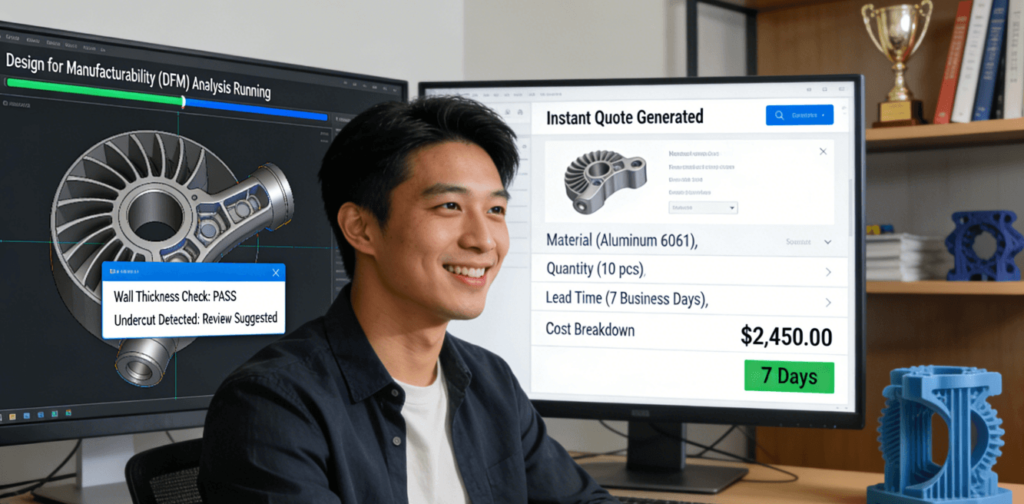
Historically, procuring a complex machined part involved a tedious cycle of back-and-forth communication. Engineers would need to explain design intent, clarify tolerances, and await manual assessments, a process that could stretch for days before even receiving a quote. Modern Digital Manufacturing Services have revolutionized this through intelligent online quote CNC machining service platforms.
The procedure is now efficient and open. A designer only needs to upload a 3D model (for example, in STEP or IGES format). A highly sophisticated program runs a quick, hands-off “Design for Manufacturability” (DFA) check, pointing out at any issues, e.g. very thin walls, unaccessible features, or difficult-to-manufacture aspect ratios. Then, with the help of a huge database of material costs and machining logistics, a fully-fledged detailed itemized quotation is ready within minutes, not days. Such openness and swiftness convert the buying of “Precision Custom 5 Axis Parts” into an easy, hassle-free experience as opposed to a prolonged negotiation, thus significantly improving the supply chain agility.
How to Design for Manufacturing to Maximize 5-Axis Advantages and Control Cost?
To maximize the potential of 5-axis machining, engineers should embrace a Design for Manufacturability (DFM) philosophy with this technology in mind. Working with a manufacturing partner early in the design phase is vital to maximize both performance and cost benefits.
Feature Consolidation and Topology Optimization
One of the strongest benefits is the ability to make a single, complex piece that might have required assembly of multiple parts. Engineers should think in terms of feature consolidation and topology optimization to make strong, lightweight single parts. This is especially useful with aluminum 5-axis CNC service, where the material is very machinable and therefore allows for high material removal and complex geometry, resulting in reduced parts, weight, and labor.
Designing for Tool Accessibility and Stability
Although 5-axis machines provide more access, design considerations can minimize any associated cost escalations.
- Internal Radii and Deep Pockets:
Defining an internal corner radius equal to or greater than standard tooling sizes can eliminate the need for expensive, brittle custom tooling. Defining a depth-to-width ratio of pockets can also provide stability. - Thin-Wall Distortion:
Designing equal wall sections and incorporating ribs or gussets can prevent part vibrations or distortions during machining, particularly in tall, thin sections.
Working with a skilled axis parts processing service provider from a young age can be incredibly beneficial. For example, the detailed design white papers and guides from experienced professionals such as those at CNC Protolabs provide valuable DFM advice on complex parts. Additionally, choosing a supplier that has been certified to extremely stringent industry standards such as IATF 16949 (Automotive) and AS9100D (Aerospace) ensures DFM advice is based on a quality system capable of producing parts at extremely high volumes.
In Which High-End Applications Has 5-Axis Machining Become Indispensable?
5 Axis CNC Machining Service has evolved from a luxury to a necessity in many high-tech industries where complexity, performance, and material integrity are non-negotiable. The best Technology Service Providers have made it a part of their key expertise.
Aerospace: Pushing the Boundaries of Performance
The aerospace industry depends on 5 axis machining for mission-critical parts. A quintessential example would be 5-axis impeller machining. The closely spaced and twisted blades of a turbine or compressor impeller, with concave surfaces and narrow channels, are virtually impossible to achieve without the aid of 5 axis machining. This process is critical to attaining the aerodynamic performance and strength required in modern jet propulsion systems. The National Aeronautics and Space Administration(NASA) technical reports have documented the process of employing 5 axis machining to improve the cooling efficiency of turbine parts, which in turn directly relates to performance and lifespan.
Medical: Enabling Patient-Specific Care
The medical industry uses 5-axis technology to machine customized surgical guides, orthopedic implants, and dental prosthetics. These parts require complex shapes, which are often organic in nature, derived from patient images obtained from a CT scan. They need to fit perfectly with the human anatomy. 5-axis machining helps achieve such complex parts from materials like titanium and PEEK.
Energy and Automotive: Demanding Environments
- Energy Sector:
Components like gas turbines require parts like blades, vanes, and complex housings. They need materials like Inconel, which offer high heat resistance. 5-axis machining helps machine complex internal passages needed for efficient cooling.
- High-Performance Automotive:
From complex chassis components to intricate fluid manifolds, 5-axis machining helps achieve complex parts needed in lightweight structures. This helps in achieving complex parts needed in motorsports.
For engineers looking to access such advanced 5 axis CNC machining services , a key part of the selection process is to assess a supplier’s experience in working on such projects in these industries.
Conclusion
Ultimately, the whole notion of 5-axis CNC machining being just a high priced niche technology is far from the truth; it is actually a revolutionary approach to manufacturing logic that allows companies to shorten their lead times and lower their total costs. In fact, the benefit of this technology can be seen at each step of the process – from design collaboration and intelligent online quoting to highly accurate production in a single setup. By adopting this technology, companies are developing essential capabilities that will serve them well in the agile, complex production environment of the future.
In order to turn this capability for project success into something tangible, you need to find a partner who not only has the technical skills but also has thoroughly demonstrates that these skills are backed up by systems and processes that are certified to ISO 9001 and ISO 13485, among others, and who have a track record of working collaboratively with their customers and listening to their needs in order to deliver exactly what was required without any issues. CNC Protolabs, for example, specializes in manufacturing complex components; they have the technical knowledge, experience, and capability to make it a reality, transforming complicated designs into dependable, high-quality parts that perform extremely well.
Author Bio
This article is the work of a senior engineer who has spent more than 10 years growing his career in the precision manufacturing industry. He is well-versed in advanced CNC technologies and knows the aces of manufacturing process optimization and supply chain efficiency. His intention is to share with the manufacturing community the most practical helpful information.
FAQs
Q: What is the usual Minimum Order Quantity (MOQ) for 5-axis machining?
A: In fact, nowadays a lot of 5 axis CNC machining factories are not only capable of low volume productions but even single piece productions. They have flexible programming and fixture systems which makes them very suitable for prototyping and custom batches.
Q: How long does it normally take from receiving an online quote to getting the part?
A: If 5-axis machining is used for the production of a complex part, prototype lead times can be as short as 5-7 business days. Besides the complexity of the part, availability of material and post-processing requirements also affect the timeframe, among other things.
Q: What materials can be used with 5-axis machining?
A: Among the many materials that have been processed by 5-axis machining can be found copper, cast iron and ABS as well as aluminum, stainless steel and titanium. It also covers engineering plastics such as PEEK and nylon, all of which are processed with high precision by 5-axis machining.
Q: Can I get a meaningful quote with only a conceptual sketch?
A: In order to get the right quote, we need to have the full 3D model created (e.g. the STEP format). However, some suppliers offer conceptual consulting and can come up with preliminary feasibility analysis based on sketches.
Q: How is my design’s intellectual property protected during 5-axis machining?
A: Top-line manufacturers sign very stringent Non-Disclosure Agreements (NDAs) and only operate with files inside secure internal systems. Also, choosing a supplier who has been certified to standards such as ISO 9001 can provide you with a greater degree of assurance that the processes are safe.