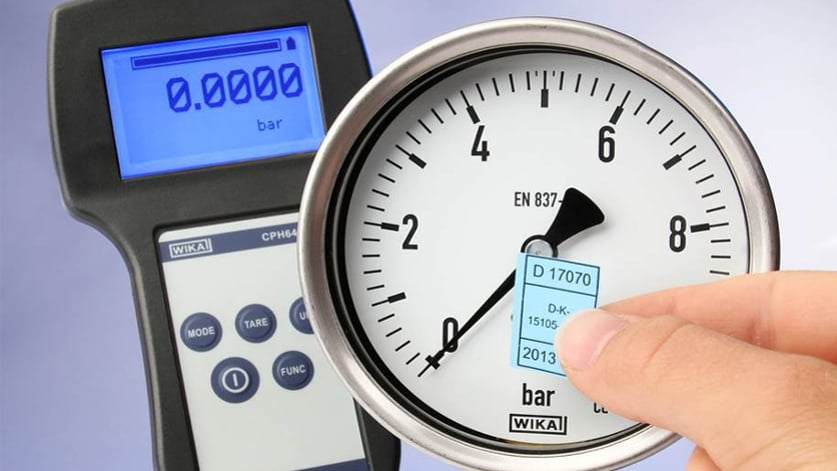
Measurement uncertainty is one of the most misunderstood—but most critical—elements of calibration. In regulated industries, the quality of a calibration does not rely solely on whether an instrument “passes” or “fails.” Instead, compliance depends on whether the measurement system’s uncertainty is known, controlled, documented, and appropriate for the tolerances of the equipment and processes it supports.
SIMCO helps organizations establish accurate, traceable, and defensible calibration programs by quantifying and documenting measurement uncertainty using accredited procedures. Understanding uncertainty is essential for preventing audit findings, minimizing risk, and ensuring that decisions based on measurement data are scientifically valid.
What Is Measurement Uncertainty?
Measurement uncertainty defines the range within which the true value of a measurement lies. Every measurement—no matter how precise—has some degree of variation. Calibration laboratories quantify this variation to ensure results are both reliable and traceable.
Uncertainty includes contributions from:
- Reference standards
- Environmental factors
- Equipment repeatability
- Technician technique
- Instrument resolution
- Drift and stability
- Calibration method limitations
Regulators and auditors expect organizations to understand and evaluate this uncertainty when determining whether an instrument is suitable for its intended use.
Why Measurement Uncertainty Matters in Regulated Industries
1. Compliance With ISO/IEC 17025 Requirements
ISO/IEC 17025 mandates that accredited laboratories identify, calculate, and report measurement uncertainty for applicable calibrations. Without documented uncertainty, calibration data is not considered technically valid or traceable.
2. Fit-for-Purpose Equipment Qualification
An instrument may fall within tolerance after calibration, but if its uncertainty is too large relative to process requirements, the instrument is not acceptable for use. This is a frequent cause of audit findings.
3. Avoiding False Accept and False Reject Decisions
Uncertainty helps determine whether the measurement system is capable of supporting required tolerances. Without this knowledge:
- A false accept could cause nonconforming parts to pass inspection.
- A false reject could cause unnecessary scrap, rework, or downtime.
4. Regulatory and Customer Audit Expectations
FDA, FAA, DoD, automotive, and aerospace auditors routinely request uncertainty data to validate calibration credibility.
How Laboratories Calculate Measurement Uncertainty
SIMCO uses standardized approaches based on GUM (Guide to the Expression of Uncertainty in Measurement) and ISO/IEC 17025 guidelines.
Typical components include:
1. Reference Standard Accuracy
The uncertainty of the standard itself contributes directly to final results.
2. Environmental Conditions
Temperature, humidity, vibration, and stability affect measurements, especially for dimensional, electrical, and temperature equipment.
3. Repeatability and Reproducibility
Multiple test cycles reveal variation in the measurement process.
4. Method and Equipment Limitations
Resolution limits, test setup variability, and technician influence all play roles.
SIMCO documents all of these components in the calibration certificate, providing clients with clear traceability and defensible data.
How Measurement Uncertainty Influences Calibration Decisions
Before Calibration:
Uncertainty determines whether the laboratory’s capability is sufficient for the tolerance being measured.
During Calibration:
Uncertainty defines the acceptable range of measured values.
After Calibration:
Uncertainty helps organizations decide whether:
- The instrument is suitable for its application
- Calibration intervals should change
- Additional controls are needed
For example, facilities requiring high-accuracy dimensional verification often rely on SIMCO’s accredited dimensional calibration services, while electronic test environments depend on precise electrical calibration to maintain uncertainty within acceptable limits.
Benefits of Understanding and Managing Uncertainty
- Greater confidence in measurement results
- Improved audit readiness
- Stronger risk assessments and control plans
- Reduced defective product rates
- Better decision-making around equipment replacement
- Optimization of calibration intervals
Organizations with mission-critical measurement equipment regularly depend on SIMCO’s comprehensive calibration management programs, which integrate uncertainty analysis into long-term equipment strategies.
Conclusion
Measurement uncertainty is not simply a technical detail—it is the foundation of reliable, compliant calibration. By quantifying and documenting uncertainty, SIMCO enables regulated industries to make defensible decisions, maintain audit readiness, and ensure the integrity of every measurement used in production, testing, and quality assurance.